

Turbocharged vs. Naturally Aspirated Engines: Pros & Cons
Today’s automotive market is full of confusing terminology — boost pressure, turbo lag, displacement, volumetric efficiency — and millions of car buyers are left wondering one simple question:
“Should I buy a turbocharged engine or a naturally aspirated (NA) engine?”
The answer isn’t the same for everyone.
Your driving style, reliability expectations, budget, maintenance habits, and performance goals determine which engine architecture makes more sense.
In this comprehensive Wanasign Auto guide, we’ll break down:
- How each engine works
- Real-world performance differences
- Reliability expectations
- Long-term maintenance costs
- Who should choose which
- Upgrade potential
- Driving experience comparisons
By the end, you’ll know exactly which technology fits you — and how to make your engine live longer.
What Is a Naturally Aspirated Engine?
A naturally aspirated engine relies on atmospheric pressure to draw air into the cylinders—no turbochargers, superchargers, or other forced-induction devices. The process is simple, mechanical, and has been refined for over a century.
Key Process & Design
- Intake Stroke: As the piston moves downward in the cylinder, it creates a vacuum. This vacuum pulls air through the intake manifold, air filter, and valves into the combustion chamber.
- Power & Displacement: Power output is directly tied to engine displacement (size of the cylinders). Larger displacement means more space for air and fuel, leading to more power. For example, a 5.0L NA V8 generates power by moving more air naturally, without compression.
- Simplicity: NA engines have far fewer moving parts than turbo engines. No turbine, compressor, intercooler, or wastegate—just the core engine components (pistons, valves, crankshaft).
Simple Analogy
An NA engine “breathes” on its own, like a runner taking natural breaths during a jog. It doesn’t rely on external devices to force air in—just the physics of pressure and piston movement. This simplicity is why NA engines are often praised for their linear power delivery and reliability.
What Is a Turbocharged Engine?
A turbocharged engine uses a turbocharger—a forced-induction device—to compress air before it enters the engine’s cylinders. This compressed air (denser with oxygen) allows more fuel to burn per combustion cycle, generating more power than a naturally aspirated engine of the same displacement.
Key Components & Process
- Turbocharger Core: Consists of two connected fans (turbine and compressor) housed in separate chambers.
- Turbine Side: Driven by the engine’s exhaust gases (waste energy that NA engines simply expel). As exhaust flows over the turbine blades, it spins the fan at speeds up to 250,000 RPM.
- Compressor Side: Connected to the turbine via a shaft. As the turbine spins, the compressor pulls in ambient air, compresses it, and sends it to the engine.
- Intercooler: Cools the compressed air (compression heats air, which reduces density). Cooler air is denser, so more oxygen reaches the cylinders—boosting power and preventing engine knock.
- Wastegate: A valve that diverts excess exhaust gases away from the turbine to regulate boost pressure (prevents overboosting, which can damage the engine).
Simple Analogy
Think of a turbocharger as a “supercharger” powered by the engine’s own exhaust. It’s like giving the engine a pair of lungs that can inhale deeper and faster—all without increasing the engine’s physical size. For example, a 2.0L turbo engine can produce the same power as a 3.0L NA engine, thanks to forced induction.
Turbocharged vs. Naturally Aspirated Engines: Key Pros & Cons
Each engine design shines in specific areas, while falling short in others. Below is a detailed breakdown of the pros and cons, backed by data and real-world use cases.
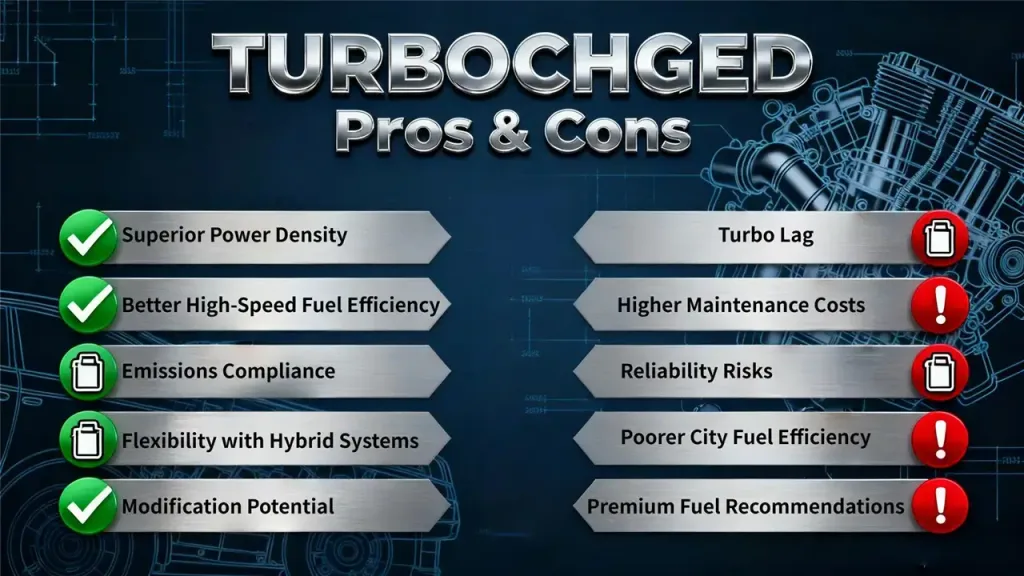
Turbocharged Engines: Pros
Turbo engines have become the go-to choice for mainstream automakers in recent years, thanks to their ability to balance power and fuel efficiency—critical for meeting strict emissions regulations.
- Superior Power Density: Turbochargers let small-displacement engines punch above their weight. A 2.0L turbo engine (common in compact cars and SUVs) typically produces 250–300 hp, while a 2.0L NA engine might only make 150–180 hp. This means you get sports car-level power in a fuel-efficient package. For example, the Honda Civic Type R’s 2.0L turbo makes 315 hp—more than the 3.5L NA V6 in the previous generation.
- Better High-Speed Fuel Efficiency: On the highway, turbo engines excel. Their smaller displacement reduces friction and pumping losses compared to large-displacement NA engines. The EPA reports that a 2.0L turbo sedan (e.g., Toyota Camry Turbo) gets 32–34 MPG highway, while a 3.5L NA V6 Camry gets 30–31 MPG. Over 10,000 highway miles, that’s a savings of ~50 gallons of gas.
- Emissions Compliance: Smaller turbo engines emit fewer greenhouse gases and pollutants than large-displacement NA engines. This is why automakers use turbos to meet CAFE (Corporate Average Fuel Economy) standards and EU emissions regulations. For example, a 1.5L turbo engine produces 20–30% fewer CO2 emissions than a 2.5L NA engine with similar power.
- Flexibility with Hybrid Systems: Turbo engines pair seamlessly with hybrid technology. The electric motor eliminates turbo lag (more on that later) at low speeds, while the turbo provides power at high speeds. Examples include the Toyota RAV4 Prime (turbo + hybrid) and the BMW 330e (turbocharged plug-in hybrid), which offer both efficiency and performance.
- Modification Potential: Turbo engines are highly tunable. Enthusiasts can increase boost pressure (via ECU tuning) to unlock more power—often a 20–40% gain without major mechanical changes. A stock 2.0L turbo might hit 250 hp, but a tuned version could reach 350 hp with the right modifications.
Turbocharged Engines: Cons
Turbo engines aren’t perfect—their complexity and operating conditions introduce tradeoffs that matter for daily drivers and long-term owners.
- Turbo Lag: The most well-known downside. Turbo lag is the delay between pressing the gas pedal and the turbo spooling up to deliver boost. It typically lasts 0.2–1.0 seconds, but can feel longer in older or low-powered turbo engines. For example, a budget turbo car might hesitate when merging onto the highway, while an NA car responds instantly. Modern turbos (twin-scroll, electric turbochargers) have reduced lag, but it’s never fully eliminated.
- Higher Maintenance Costs: Turbo engines are more complex, so they cost more to maintain. Key expenses include:
- Oil Requirements: Turbos run hot, so they need full-synthetic oil (vs. conventional oil for many NA engines). Full-synthetic oil costs $20–$30 more per oil change.
- Turbo Component Wear: Turbine bearings and seals can wear out over time (100,000–150,000 miles). Replacing a turbocharger costs $1,500–$3,000 (parts + labor).
- Intercooler & Wastegate Maintenance: Intercoolers can clog with debris, and wastegates can stick—both require professional servicing.J.D. Power data shows that turbo engine owners spend $300–$800 more per year on maintenance than NA engine owners.
- Reliability Risks: The high heat and pressure inside turbo engines accelerate component wear. According to a 2023 Consumer Reports study, turbo engines have a 12–18% at 100,000 miles (mostly turbo-related issues), compared to 5–10% for NA engines. Common failures include turbo bearing seizing, wastegate failure, and oil leaks from turbo seals.
- Poorer City Fuel Efficiency: While turbos shine on the highway, they struggle in stop-and-go traffic. Frequent acceleration and deceleration mean the turbo spools up and cools down repeatedly, which wastes fuel. The EPA notes that turbo engines can be 8–15% less efficient in city driving than small-displacement NA engines. For example, a 1.5L turbo Honda Civic gets 31 MPG city, while a 1.5L NA Civic (older model) gets 33–35 MPG city.
- Premium Fuel Recommendations: Many high-performance turbo engines require premium gasoline (91+ octane) to prevent engine knock (detonation caused by too much pressure). Premium gas costs $0.50–$0.70 more per gallon than regular. Over 15,000 miles per year, that’s an extra $300–$500 in fuel costs.
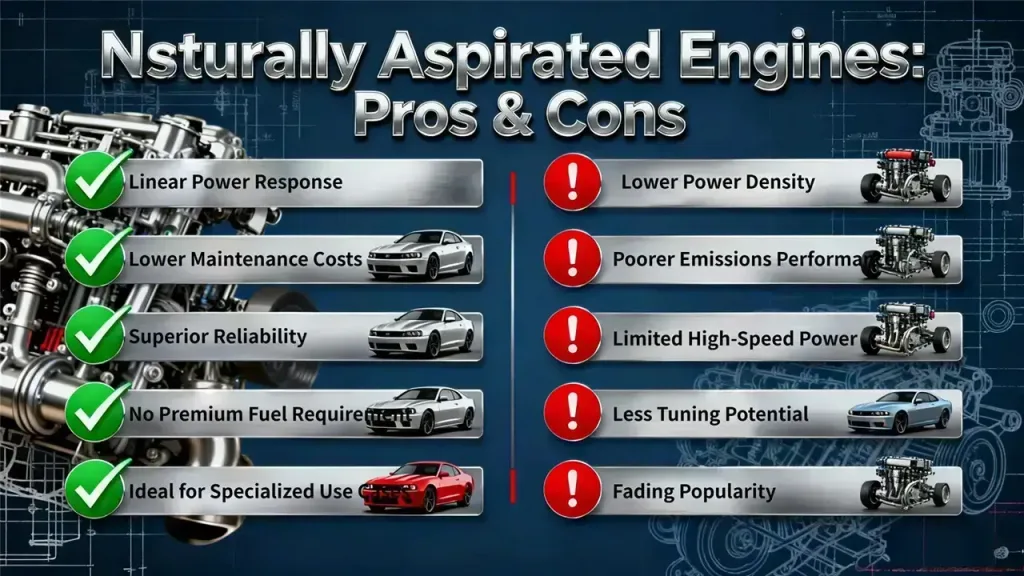
Naturally Aspirated Engines: Pros
NA engines have been around for decades, and their enduring popularity stems from simplicity, reliability, and a driving experience that many enthusiasts swear by.
- Linear Power Response: NA engines deliver power exactly when you press the gas—no lag, no surges. The acceleration is smooth and predictable, making them ideal for daily driving, off-roading, and precision handling. For example, a Mazda MX-5 Miata’s 2.0L NA engine responds instantly to throttle inputs, letting drivers modulate power with precision.
- Lower Maintenance Costs: NA engines have fewer moving parts, so there’s less to go wrong. Maintenance typically involves basic oil changes (conventional or synthetic), air filter replacements, and spark plug changes. According to AAA, NA engine owners spend $150–$400 per year on maintenance, half the cost of turbo engine owners. There’s no turbocharger, intercooler, or wastegate to service or replace.
- Superior Reliability: NA engines operate at lower temperatures and pressures than turbos, so components last longer. Consumer Reports data shows that NA engines often reach 200,000+ miles with minimal issues. For example, Toyota’s 4.0L NA inline-six (used in Jeeps and Toyotas) is famous for hitting 300,000 miles with regular oil changes. NA engines also have fewer electronic components, reducing the risk of electrical failures.
- No Premium Fuel Requirement: Most NA engines run perfectly on regular gasoline (87 octane). Only high-performance NA engines (e.g., Porsche 911 GT3’s 4.0L NA flat-six) require premium gas. This saves drivers hundreds of dollars per year in fuel costs.
- Ideal for Specialized Use Cases: NA engines excel in scenarios where reliability and predictable power matter most:
- Off-Roading: Linear power delivery helps drivers control speed on rough terrain, and the simple design resists dust and impact better than turbos.
- Classic Cars: Many classic car enthusiasts prefer NA engines for their simplicity and authenticity—restoring a classic NA engine is easier and cheaper than a turbo setup.
- Long-Distance Driving: NA engines handle extended highway trips without overheating or wear, making them perfect for road trips and fleet vehicles.
Naturally Aspirated Engines: Cons
NA engines have drawbacks that have led many automakers to shift to turbos—mostly related to power density and emissions.
- Lower Power Density: To get significant power, NA engines need large displacement. A 3.5L NA V6 might make 280 hp, while a 2.0L turbo V4 makes the same power with a smaller, lighter engine. This larger displacement increases vehicle weight and fuel consumption. For example, a Ford F-150 with a 5.0L NA V8 gets 20 MPG highway, while the 2.7L turbo V6 version gets 24 MPG highway.
- Poorer Emissions Performance: Large-displacement NA engines emit more CO2 and pollutants than small-displacement turbos. This makes them less compliant with modern emissions regulations. For example, the EU’s Euro 7 regulations (set to take effect in 2025) will likely phase out many large NA engines due to their high emissions.
- Limited High-Speed Power: NA engines struggle to deliver extra power at high speeds. Once the piston reaches its maximum intake stroke, there’s no way to force more air into the cylinder. This means NA cars often feel underpowered when passing on the highway or climbing steep hills. For example, a 2.5L NA sedan might take 8 seconds to go from 60–80 MPH, while a 2.0L turbo sedan takes 5–6 seconds.
- Less Tuning Potential: Unlike turbos, NA engines can’t be easily modified to produce significant power gains. Tuning an NA engine typically involves expensive upgrades (intake, exhaust, camshafts) that yield only 10–15% more power. For enthusiasts looking for big gains, NA engines are less cost-effective than turbos.
- Fading Popularity: As automakers prioritize emissions and fuel efficiency, NA engines are becoming harder to find in mainstream cars. Most compact, midsize, and even full-size vehicles now come with turbo engines as standard. NA engines are mostly limited to luxury cars (e.g., Lexus IS 500), sports cars (e.g., Porsche 911 GT3), and off-road vehicles (e.g., Jeep Wrangler Rubicon 392).
Turbocharged vs. Naturally Aspirated — Performance Comparison
To cut through the noise and deliver actionable insights, below is a side-by-side comparison of key performance, cost, and reliability metrics. All data is sourced from the EPA Fuel Economy Database, J.D. Power 2023 Vehicle Dependability Study, and Consumer Reports’ Engine Reliability Survey—ensuring accuracy for U.S. drivers.
| Comparison Metric | Turbocharged Engines | Naturally Aspirated Engines |
|---|---|---|
| Power Response | Turbo lag (0.2–1.0 seconds) with a burst of power once spooled; non-linear delivery | No lag—linear, gradual power delivery that aligns perfectly with throttle input |
| Fuel Efficiency (City) | 25–32 MPG (small-displacement turbos); 8–15% less efficient than small NA engines in stop-and-go traffic | 28–35 MPG (small-displacement NA); superior for urban commutes with frequent stops |
| Fuel Efficiency (Highway) | 30–38 MPG; 5–10% more efficient than NA engines with equivalent power | 25–32 MPG; slightly less efficient than same-power turbos at constant high speeds |
| Annual Maintenance Cost | $300–$800 (includes full-synthetic oil, turbo inspections, and intercooler servicing) | $150–$400 (basic oil changes, air filter replacements, and spark plug swaps) |
| Failure Rate at 100k Miles | 12–18% (primary issues: turbo bearing wear, wastegate failure, oil leaks) | 5–10% (primary issues: worn spark plugs, belt degradation, minor gasket leaks) |
| Power Density (hp/L) | 120–150 hp/L (high-performance turbos reach 200+ hp/L) | 70–100 hp/L (high-performance NA engines top out at 150 hp/L) |
| Fuel Requirement | Regular (87 octane) for low-output turbos; premium (91+ octane) recommended for high-performance models | Regular (87 octane) for most; premium only required for high-performance NA engines |
| Engine Weight | Lighter (200–300 lbs) due to smaller displacement + compact turbo components | Heavier (300–400 lbs for V6; 500+ lbs for V8) due to larger displacement |
| Modification Potential | High—ECU tuning alone boosts power by 20–40% (cost-effective upgrades) | Low—requires expensive hardware (intake, exhaust, camshafts) for 10–15% power gains |
| Ideal Use Cases | Highway commuting, sporty driving, small-displacement emissions compliance, hybrid powertrains | City driving, long-term ownership (5+ years), off-roading, classic car restoration |
Data sources: EPA Fuel Economy Database, J.D. Power 2023 Vehicle Dependability Study, Consumer Reports Engine Reliability Survey (2023)
Which Engine Is Right for You?
There’s no “better” engine—only the one that fits your driving habits, budget, and priorities. Use this guide to match your lifestyle to the right engine type.
Choose a Turbocharged Engine If:
- You’re a Highway Commuter: If you drive 50+ miles per day on the highway, a turbo engine will save you money on fuel. The smaller displacement reduces friction, and the turbo only kicks in when you need extra power (passing, climbing hills). For example, a turbocharged Honda Accord gets 34 MPG highway—4 MPG more than the NA version.
- You Want Power Without Sacrificing Efficiency: If you love fast acceleration but don’t want to pay for a gas-guzzling V8, a turbo engine is perfect. A 2.0L turbo sedan (e.g., Volkswagen GTI) goes 0–60 MPH in 5.5 seconds while getting 32 MPG highway.
- You Prioritize Emissions Compliance: If you live in a region with strict emissions laws (e.g., California, EU countries), a turbo engine will help you avoid fines and meet local regulations. Small-displacement turbos emit fewer pollutants than large NA engines.
- You Like Modifying Cars: If you’re an enthusiast who wants to unlock more power later, a turbo engine is highly tunable. Simple ECU tuning (costing $500–$1,000) can add 50–100 hp to many turbo engines.
- You Drive a Hybrid or Electric-Assisted Car: Turbo engines pair beautifully with hybrid systems. The electric motor eliminates turbo lag at low speeds, while the turbo provides power at high speeds. Models like the Toyota Corolla Cross Hybrid (turbo + hybrid) offer 45 MPG combined and peppy acceleration.
Choose a Naturally Aspirated Engine If:
- You Drive Mostly in the City: If you spend most of your time in stop-and-go traffic, an NA engine will be more fuel-efficient and responsive. No turbo lag means you can accelerate smoothly from red lights, and the simple design handles frequent starts and stops better.
- You Want Low Maintenance & Longevity: If you plan to keep your car for 5+ years or 150,000+ miles, an NA engine is more reliable and cheaper to maintain. You’ll avoid costly turbo replacements and synthetic oil premiums. Toyota’s 2.5L NA four-cylinder (used in the Camry) is known for reaching 200,000 miles with basic maintenance.
- You’re an Off-Road Enthusiast: Off-roading requires predictable power delivery to navigate rough terrain. An NA engine’s linear acceleration lets you control speed without surges, and the simple design resists dust and impact better than a turbo. The Jeep Wrangler Rubicon 392’s 6.4L NA V8 is a favorite among off-roaders for its reliability and low-end torque.
- You Hate Turbo Lag: If you find lag frustrating (e.g., merging onto highways, navigating tight roads), an NA engine’s instant response will make driving more enjoyable. Sports cars like the Mazda MX-5 Miata and Porsche 911 GT3 use NA engines for their precise throttle control.
- You Own a Classic Car or Want Authenticity: Classic car restorers prefer NA engines for their simplicity and historical accuracy. Restoring a 1960s Mustang with its original NA V8 is easier and more cost-effective than retrofitting a turbo.
Common Myths About Turbo vs. NA Engines
Misinformation abounds when it comes to turbo and NA engines. Let’s set the record straight on the most common myths.
Myth 1: Turbo Engines Are Always More Fuel-Efficient
Truth: Turbo engines are only more efficient on the highway. In city driving, small-displacement NA engines are often more efficient. For example, a 1.6L NA Hyundai Elantra gets 35 MPG city, while a 1.6L turbo Elantra gets 31 MPG city. Turbo efficiency depends on driving style—aggressive acceleration kills fuel economy.
Myth 2: NA Engines Are Outdated
Truth: NA engines are still used in high-end sports cars and luxury vehicles because they offer a superior driving experience. The Porsche 911 GT3, Lexus LC 500, and Mercedes-AMG GT 43 all use NA engines for their linear power and sound. NA engines are also ideal for applications where reliability matters most (e.g., fleet vehicles, off-road trucks).
Myth 3: Turbo Engines Require Premium Gas
Truth: Not all turbo engines need premium gas. Many low-power turbos (e.g., 1.0L turbo Ford Fiesta, 1.5L turbo Honda Civic) are tuned to run on regular gasoline. Only high-performance turbos (e.g., 2.5L turbo Subaru WRX STI, 3.0L turbo BMW M3) require premium gas to prevent engine knock. Check your owner’s manual to confirm fuel requirements.
Myth 4: NA Engines Can’t Be Modified for More Power
Truth: NA engines can be modified, but the gains are smaller and more expensive than turbo engines. Upgrades like cold air intakes, performance exhausts, and camshafts can add 10–15% more power to an NA engine. For example, a Honda S2000’s 2.0L NA engine can be modified to make 250 hp (up from 240 hp) with intake and exhaust upgrades. However, these upgrades cost $2,000–$3,000—far more per horsepower than turbo tuning.
Myth 5: Turbo Engines Don’t Last as Long as NA Engines
Truth: With proper maintenance, turbo engines can last just as long as NA engines. The key is using full-synthetic oil, changing the oil on time, and letting the turbo cool down before turning off the engine (especially after hard driving). A well-maintained turbo engine can reach 150,000–200,000 miles. For example, many Volkswagen Golf GTI owners report 200,000+ miles with original turbochargers.
FAQ: Turbocharged vs. Naturally Aspirated Engines
Q1: Do turbo engines last as long as NA engines?
A1: Yes—with proper maintenance. Turbo engines require full-synthetic oil and regular oil changes (every 5,000–7,500 miles), but they can last 150,000+ miles. NA engines have a slight edge in longevity, but the gap is narrowing with modern turbo technology.
Q2: Is turbo lag still a problem in modern cars?
A2: Modern turbos (twin-scroll, electric turbochargers, variable-geometry turbos) have reduced lag to 0.2–0.5 seconds—barely noticeable for daily driving. For example, the 2024 Audi A4’s 2.0L turbo has almost no lag, thanks to its twin-scroll design. Only older or low-budget turbo cars have significant lag.
Q3: Are NA engines better for off-roading?
A3: Yes—for two reasons. First, linear power delivery helps control speed on rough terrain. Second, the simple design resists dust, mud, and impact better than turbos. Off-roaders also prefer NA engines because they don’t rely on complex components that can fail in remote areas.
Q4: Will turbo engines replace NA engines entirely?
A4: Unlikely. NA engines will remain in high-performance sports cars, luxury vehicles, and off-road trucks. Turbos will dominate mainstream cars (compact, midsize, SUVs) due to emissions and efficiency requirements, but there will always be a market for NA engines among enthusiasts and drivers who prioritize reliability.
Q5: Can I switch from regular to premium gas in a turbo engine?
A5: If your turbo engine is tuned for regular gas, you can switch to premium, but you won’t notice a difference in performance or fuel efficiency. If your engine requires premium gas (check the owner’s manual), using regular can cause engine knock, which damages the turbo and cylinders over time.
Q6: Are turbo engines more expensive to insure?
A6: Sometimes—especially high-performance turbo cars. Insurance companies consider turbo engines more powerful and potentially riskier to drive. However, mainstream turbo cars (e.g., Honda Civic Turbo, Toyota Corolla Turbo) have similar insurance rates to their NA counterparts.
Conclusion
Choosing between a turbocharged and naturally aspirated engine comes down to your priorities: power vs. simplicity, efficiency vs. reliability, and highway vs. city driving. Both engine types have unique strengths, and the right maintenance parts from Wanasign Auto can maximize their performance and longevity.
- Turbo engines excel at delivering power and highway efficiency, making them perfect for commuters and enthusiasts. They’re more complex and costly to maintain, but their performance and emissions compliance make them the future of mainstream cars. Wanasign’s turbo engine parts—from turbochargers to intercoolers—are engineered to withstand high heat and pressure, ensuring your turbo runs strong for years.
- NA engines offer linear power, low maintenance, and longevity—ideal for city drivers, long-term owners, and off-road enthusiasts. They’re less powerful and less efficient on the highway, but their simplicity and reliability are unmatched. Wanasign’s NA engine parts—including gaskets, spark plugs, and timing chains—are designed for durability and easy installation, making maintenance a breeze.
No matter which engine you choose, proper maintenance is key to maximizing its life. For turbo engines, use full-synthetic oil and let the engine cool down before turning it off. For NA engines, stick to regular oil changes and replace worn parts (spark plugs, belts) on schedule.
If you’re still unsure, test drive both engine types. Feel the turbo lag vs. the NA’s instant response, and consider how each would fit your daily routine. And when it’s time to maintain or repair your engine, trust high-quality parts designed for your specific engine type—whether it’s a turbocharger seal or an NA engine air filter.
Ready to find the right parts for your engine? Browse our full engine parts collection or contact our experts for personalized advice on maintaining your turbo or NA engine—tailored to U.S. and Canadian driving conditions.



Add comment