

How to Choose the Right Oil Filter for Your Car
Choosing the right oil filter might seem like a small detail in car maintenance—but it’s one that can make or break your engine’s lifespan. The oil filter is your engine’s “first line of defense,” trapping metal shavings, carbon deposits, and sludge that would otherwise circulate through critical components. Here’s a shocking stat: A study by the Automotive Maintenance and Repair Association found that using the wrong oil filter can shorten engine life by up to 30%.
Whether you’re a DIY mechanic or just want to make informed decisions at the repair shop, this guide breaks down everything you need to know—from filter types and key features to compatibility checks and Wanasign Auto’s top recommendations. We’ll keep it simple, actionable, and tailored to everyday drivers (no technical jargon required) while highlighting why quality matters when it comes to protecting your car’s most valuable asset.
At Wanasign Auto, we specialize in premium, U.S.-spec oil filters designed for reliability and performance. Every filter undergoes rigorous testing to meet or exceed OEM standards—so you can trust your engine to our parts.
What Does an Oil Filter Do?
Before diving into how to choose one, let’s start with the basics: What exactly does an oil filter do?
Your engine’s oil has two jobs: lubricating moving parts (like pistons, bearings, and valves) and carrying away harmful debris. As oil circulates, it picks up metal shavings (from normal wear), carbon deposits (from combustion), sludge (from old oil breaking down), and even tiny pieces of gasket material. Without a filter, this debris would scratch, wear, or clog critical components—leading to overheating, reduced performance, or even catastrophic engine failure.
A quality oil filter:
- Traps particles as small as 10–20 microns (smaller than a human hair) to prevent them from damaging engine parts.
- Maintains consistent oil pressure and flow—critical for modern engines with tight tolerances (like turbocharged or hybrid models).
- Prevents sludge buildup, which can block oil passages and starve the engine of lubrication.
Think of it like a “water filter” for your engine: You wouldn’t drink unfiltered water, so don’t let your engine run on unfiltered oil. Even the best synthetic oil won’t protect your engine if paired with a cheap, ineffective filter.
Types of Oil Filters (And Which One Your Car Needs)
Not all oil filters are the same—different designs serve different purposes, and your car’s make, model, and year will dictate which type fits. Below are the five most common types, with pros, cons, and use cases:
1. Spin-On Oil Filters
The most common type of oil filter, found in 70% of U.S. vehicles (including Ford, Chevrolet, Toyota, and Honda).
- Design: A self-contained unit with a filter element, housing, and threaded base that screws directly onto the engine’s filter mount.
- Pros: Easy to replace (no tools needed for basic installs), widely available, and affordable. Perfect for DIY mechanics—you can swap it out in 5 minutes.
- Cons: Bulkier than cartridge filters, and the disposable housing creates more waste.
- Best For: Most domestic and Asian cars, trucks, and SUVs (e.g., Ford F-150, Toyota Camry, Honda Civic).
2. Cartridge Oil Filters
Common in European vehicles (BMW, Mercedes-Benz, Audi) and newer Asian models (Lexus, Acura, newer Toyotas).
- Design: A replaceable filter element (no built-in housing) that fits inside a permanent metal canister on the engine.
- Pros: More environmentally friendly (less waste, since only the filter element is replaced), lighter, and often more compact.
- Cons: Requires a special wrench to remove the canister, and messy if not handled carefully.
- Best For: European luxury cars, hybrid models, and newer vehicles with tight engine bays (e.g., BMW 3 Series, Mercedes C-Class, Toyota Prius).
3. High-Efficiency (Synthetic Media) Oil Filters
A step up from standard filters, designed for modern engines with strict filtration needs.
- Design: Uses synthetic filter media (instead of paper) to trap smaller particles while maintaining oil flow.
- Pros: Filters particles as small as 5–10 microns (vs. 15–20 microns for paper media), lasts longer, and works better with synthetic oil.
- Cons: Slightly more expensive than standard filters.
- Best For: Turbocharged engines (BMW B58, Ford EcoBoost, VW TSI), direct-injection engines, and cars with extended oil change intervals (5,000+ miles).
4. High-Flow / Performance Oil Filters
Built for engines that demand maximum oil flow (e.g., high-performance, off-road, or modified cars).
- Design: Features a larger filter element and less restrictive media to allow more oil to circulate quickly.
- Pros: Improves oil pressure in high-RPM scenarios, prevents oil starvation in modified engines, and works well with thick oil (5W-40, 10W-30).
- Cons: Less effective at trapping tiny particles (trade-off for flow), not ideal for daily drivers.
- Best For: Off-road vehicles (Jeep Wrangler, Toyota Tacoma), muscle cars (Ford Mustang, Chevrolet Camaro), and modified engines (tuned turbo cars).
5. Magnetic Oil Filters
A specialty filter that uses magnets to trap ferrous (metal) debris.
- Design: Integrates magnets into the filter housing or element to attract metal shavings (common in older engines or engines with worn parts).
- Pros: Extra protection against metal debris, which can cause the most damage to bearings and pistons.
- Cons: Doesn’t trap non-metallic debris (carbon, sludge), so it’s best used with a standard filter—not as a replacement.
- Best For: High-mileage engines (150,000+ miles), classic cars, and engines with known wear issues (e.g., old trucks with loose bearings).
Key Factors to Consider When Choosing an Oil Filter
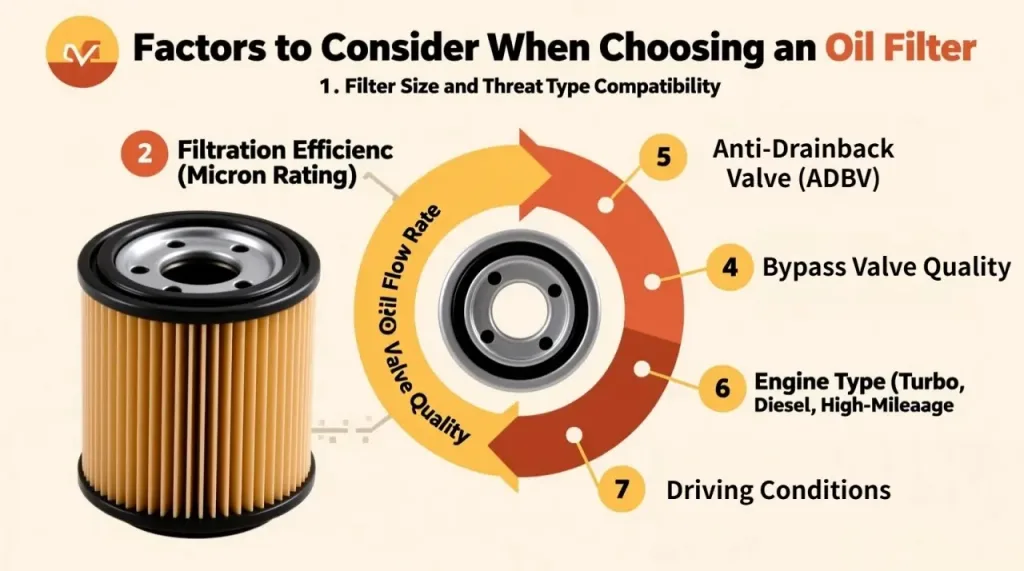
Now that you know the types, let’s break down the critical factors that determine if a filter is right for your car. Skip any of these, and you risk buying a filter that doesn’t fit, doesn’t protect, or even damages your engine.
1. Filter Size and Thread Type Compatibility
This is non-negotiable: The filter must match your engine’s specifications exactly.
- How to Check:
- Consult your vehicle’s owner’s manual (look for “oil filter specifications” or part number).
- Use Wanasign’s oil filter cross-reference tool to match your car’s make/model/year to the correct filter.
- Check the thread size (e.g., 3/4-16, M20x1.5) and gasket diameter—these must match the engine’s filter mount.
- What Happens If It’s Wrong:
- An oversized filter may not fit in the engine bay, or it could block other components.
- An undersized filter will leak oil (due to a mismatched gasket) or fail to seal properly.
- The wrong thread type won’t screw on, or it could strip the engine’s filter mount (costly to repair).
Pro Tip: Never buy a “universal” filter—they rarely fit perfectly. Stick to filters designed for your specific vehicle.
2. Filtration Efficiency (Micron Rating)
Filtration efficiency refers to how well the filter traps small particles, measured in microns (μm).
- Nominal vs. Absolute Micron Rating:
- Nominal rating: The filter traps 50–90% of particles of a given size (e.g., a “10μm nominal” filter catches 50% of 10μm particles).
- Absolute rating: The filter traps 99.9% of particles of a given size (superior for protection).
- Recommended Range: For most cars, a filter with an absolute rating of 10–20μm is ideal. Turbocharged or high-performance engines need 5–10μm (synthetic media) for maximum protection.
- Why It Matters: Particles smaller than 20μm can scratch bearings and cylinder walls, leading to premature wear. Over time, this wear reduces engine power and increases oil consumption.
3. Oil Flow Rate
Oil flow rate is how much oil passes through the filter per minute—critical for keeping your engine lubricated, especially during cold starts or high-RPM driving.
- Restrictive Filters Are Bad: A filter with too dense media will reduce oil flow, leading to oil starvation (no oil reaching critical parts). This is especially dangerous for turbo engines, which rely on fast oil flow to cool the turbo bearing.
- High-Flow Isn’t Always Better: For daily drivers, a standard flow rate is fine. High-flow filters are only necessary for modified engines or off-road vehicles that demand more oil.
- How to Check: Look for filters rated for your engine’s oil pressure (found in the owner’s manual). Wanasign’s filters are calibrated to match OEM flow rates for each vehicle.
4. Bypass Valve Quality
The bypass valve is a safety feature that opens when the filter is clogged (e.g., from sludge) to allow unfiltered oil to circulate—preventing oil starvation.
- Why It Matters: Without a bypass valve, a clogged filter would stop oil flow entirely, leading to engine seizure.
- What to Look For:
- A valve that opens at the correct pressure (typically 8–12 psi for most engines).
- A durable valve (metal or high-grade plastic) that won’t stick open or closed.
- Winter Considerations: In cold weather, oil thickens—putting more pressure on the filter. A quality bypass valve ensures oil flows even when it’s cold.
Wanasign’s filters use precision-engineered bypass valves to match OEM specifications, so you’re protected in all conditions.
5. Anti-Drainback Valve (ADBV)
The anti-drainback valve prevents oil from draining out of the filter when the engine is off—ensuring the filter is full of oil when you start the engine.
- Why It Matters: Dry starts (when the filter is empty) cause 70% of engine wear. The ADBV ensures oil reaches critical parts immediately after startup.
- Silicone vs. Rubber:
- Silicone valves are better—they resist hardening in high heat and cold temperatures (rubber valves can crack or stick after a few years).
- All Wanasign filters use silicone ADBVs for long-lasting performance.
6. Engine Type (Turbo, Diesel, High-Mileage)
Your engine’s design dictates the filter it needs:
- Turbocharged Engines: Need high-efficiency (synthetic media) filters with good flow and heat resistance. Turbo bearings run hot and are sensitive to debris—cheap filters can lead to turbo failure.
- Diesel Engines: Require larger filters with higher capacity (diesels produce more soot and sludge). Look for filters rated for diesel engines (Wanasign’s diesel oil filters are designed for heavy-duty use).
- High-Mileage Engines (150k+ miles): Benefit from filters with extra capacity and magnetic elements to trap metal debris from worn parts. Wanasign’s high-mileage oil filters include anti-sludge additives to keep old engines running smoothly.
- Hybrid/Electric Engines: Need compact, low-restriction filters (hybrid engines have smaller oil systems). Wanasign’s cartridge filters are perfect for hybrids.
7. Driving Conditions
Your driving habits also play a role in choosing a filter:
- Short Trips (≤5 miles): Frequent cold starts and incomplete oil warming cause sludge buildup. Choose a high-efficiency filter with anti-sludge additives.
- Off-Road Driving: Dirt, dust, and vibrations increase debris—opt for a high-flow filter with a durable housing (Wanasign’s off-road filters have reinforced housings).
- Towing/Heavy Loads: Extra engine stress means more heat and debris—use a heavy-duty filter with larger capacity.
- Highway Commuting (50+ miles/day): Long drives let oil reach operating temperature, burning off sludge. A standard high-efficiency filter is sufficient.
OEM vs. Aftermarket Oil Filters — Which Should You Choose?
One of the most common questions drivers ask: Should I buy an OEM (Original Equipment Manufacturer) filter or an aftermarket one? Here’s an honest comparison:
| Feature | OEM Filter | Premium Aftermarket (Wanasign) | Cheap No-Name Aftermarket |
|---|---|---|---|
| Filtration Quality | ★★★★☆ (Meets basic standards) | ★★★★★ (Exceeds OEM standards) | ★★☆☆☆ (Poor filtration) |
| Price | Higher ($15–$30) | Mid-Range ($10–$20) | Low ($5–$10) |
| Durability | High (but not always better) | Very High (reinforced housing, silicone valves) | Low (thin housing, rubber valves) |
| Compatibility | Guaranteed (made for your car) | Guaranteed (vehicle-specific designs) | Hit-or-miss (may not fit) |
| Recommended For | Daily drivers who want factory-spec | All drivers (daily, performance, off-road) | Avoid (risk of engine damage) |
Key Takeaways:
- OEM Filters: Safe, but overpriced. They’re a good choice if you’re under warranty and want to stick to factory parts—but they don’t offer better protection than premium aftermarket filters.
- Premium Aftermarket (Wanasign): The best balance of quality and value. Our filters are engineered to match or exceed OEM specifications, with better materials (synthetic media, silicone valves) and lower prices. They’re also vehicle-specific, so compatibility is guaranteed.
- Cheap Aftermarket: Never buy these. They use thin paper media, weak valves, and poor seals—they’ll leak, clog, or fail, putting your engine at risk.
At Wanasign Auto, we source our filters from ISO-certified manufacturers, with strict quality control to ensure every filter meets U.S. safety standards. You get OEM-level protection without the OEM price tag.
How to Check Which Oil Filter Fits Your Car
Follow these steps to find the perfect filter—no guesswork required:
Step-by-Step Guide:
- Check Your Owner’s Manual: This is the most reliable source. Look for the oil filter part number or specifications (size, thread type).
- Use a Cross-Reference Tool: Wanasign’s oil filter cross-reference tool lets you enter your car’s make, model, year, and engine type to find compatible filters.
- Verify Thread Spec and Gasket Diameter: If you have the old filter, check the thread size (printed on the base) and measure the gasket diameter with a ruler. Match these to the new filter.
- Confirm Pressure/Flow Requirements: For turbo or diesel engines, ensure the filter is rated for your engine’s oil pressure (found in the manual).
- Avoid “Almost Fits”: Even if a filter screws on, if it’s too tall, too short, or has a mismatched gasket, it will leak. Always choose a filter designed for your specific vehicle.
Common DIY Mistakes to Avoid:
- Choosing by “Looks”: Don’t buy a filter because it looks like your old one—different brands have different designs, even if they fit the same car.
- Ignoring Engine Variants: A 2020 Honda Civic with a 1.5L turbo uses a different filter than a 2.0L non-turbo model. Always specify your engine type.
- Buying Universal Filters: These are rarely compatible with modern engines—save yourself the hassle and buy a vehicle-specific filter.
How Often Should You Replace an Oil Filter?
The oil filter should be replaced every time you change your oil—no exceptions. Here’s a breakdown of oil change intervals (and thus filter replacement intervals) based on oil type:
| Oil Type | Replacement Interval (Mileage/Time) | Best For |
|---|---|---|
| Conventional Oil | 3,000–5,000 miles / 3–6 months | Older engines, budget-conscious drivers |
| Synthetic Blend Oil | 5,000–7,500 miles / 6–9 months | Daily drivers, moderate use |
| Full-Synthetic Oil | 7,500–10,000 miles / 9–12 months | Modern engines, turbocharged cars |
| Extended-Life Synthetic | 10,000–15,000 miles / 12–18 months | High-mileage highway commuters |
Special Cases (Shorter Intervals):
- Turbocharged Engines: Replace every 5,000–7,500 miles (turbo heat breaks down oil faster).
- High-Mileage Engines (150k+ miles): Replace every 3,000–5,000 miles (old engines burn more oil and produce more sludge).
- Off-Road/Towing: Replace every 3,000 miles (extra debris and stress).
- Short Trips: Replace every 3,000 miles (incomplete oil warming causes sludge).
Pro Tip: If you’re using extended-life oil, make sure to use an extended-life filter (Wanasign’s extended-life oil filters are designed to last 15,000 miles). A standard filter will clog before the oil needs changing.
How to Replace an Oil Filter (Quick DIY Guide)
Replacing an oil filter is one of the easiest DIY car maintenance tasks—you don’t need mechanical experience, just a few basic tools. Here’s how to do it:
Tools You’ll Need:
- New oil filter (Wanasign recommended)
- Oil drain pan
- Filter wrench (for spin-on filters; cartridge filters may need a canister wrench)
- Gloves (to protect your hands from hot oil)
- New engine oil (matching your car’s specifications)
- Funnel (for refilling oil)
Step-by-Step Instructions:
- Warm the Engine: Start the car and let it idle for 5 minutes—warm oil flows better, carrying more debris. Turn off the engine and set the parking brake.
- Drain the Oil: Locate the oil drain plug under the engine (use the owner’s manual if unsure). Place the drain pan under the plug, remove the plug with a wrench, and let the oil drain completely (5–10 minutes).
- Remove the Old Filter:
- Spin-On: Use a filter wrench to loosen the old filter (turn counterclockwise). Finish removing it by hand—be careful, it will be full of oil.
- Cartridge: Remove the canister cap with a wrench, pull out the old filter element, and discard it. Clean the canister housing with a rag.
- Prepare the New Filter:
- Spin-On: Apply a thin layer of new oil to the filter’s rubber gasket (prevents leaks). Fill the filter with new oil (optional but recommended for faster lubrication on startup).
- Cartridge: Insert the new filter element into the canister. Replace the O-ring with the one included in the kit (apply oil to the O-ring to prevent cracking).
- Install the New Filter:
- Spin-On: Screw the filter on by hand until the gasket touches the engine mount. Tighten it an additional 3/4 turn (don’t over-tighten—this can strip the threads or damage the gasket).
- Cartridge: Reinstall the canister cap and tighten it to the manufacturer’s torque spec (usually 18–25 ft-lbs).
- Refill the Oil: Replace the drain plug (tighten to spec), then use a funnel to refill the engine with new oil. Check the oil level with the dipstick—add more if needed.
- Check for Leaks: Start the engine and let it idle for 2–3 minutes. Check under the car for oil leaks (around the filter and drain plug). If there’s a leak, turn off the engine and tighten the filter or plug slightly.
Pro Tip: Dispose of used oil and filters properly—most auto parts stores accept them for free.
FAQ
Q1: What happens if I use the wrong oil filter?
A: Using the wrong oil filter can cause oil leaks, reduced oil pressure, dry starts, or engine damage. A filter that’s too small won’t seal; a clogged or restrictive filter can starve the engine of oil. In extreme cases, it can lead to engine seizure.
Q2: Is a more expensive oil filter worth it?
A: Yes—especially for turbocharged, high-performance, or high-mileage engines. Cheap filters use thin media and weak valves, which fail quickly. Premium filters (like Wanasign) cost $5–$10 more but protect your engine for 100,000+ miles.
Q3: Can I reuse an oil filter?
A: Never reuse an oil filter. Once it’s used, the media is clogged with debris, and the valves may be worn. Reusing a filter is like reusing a water filter—you’re circulating dirty oil through your engine.
Q4: How do I know my oil filter is failing?
A: Signs of a failing oil filter include: low oil pressure warning light, ticking/knocking engine noise (from oil starvation), dirty or black oil (even after an oil change), metal flakes in the oil, or oil leaks under the car.
Q5: Do I need a special filter for synthetic oil?
A: Yes—synthetic oil flows faster and lasts longer, so it needs a filter with synthetic media (to trap tiny particles) and a durable bypass valve. Wanasign’s synthetic oil filters are designed to work with all oil types, including full-synthetic.
Q6: Can I mix oil filter brands?
A: Yes, as long as the filter is compatible with your car. However, we recommend sticking to one brand (like Wanasign) to ensure consistent quality and performance.
Conclusion
Choosing the right oil filter isn’t a decision to take lightly—it’s one of the most important ways to protect your engine’s lifespan and performance. By considering your car’s make, engine type, driving habits, and key filter features (compatibility, filtration efficiency, valves), you can find a filter that keeps your engine running smoothly for 200,000+ miles.
At Wanasign Auto, we’re committed to providing premium, affordable oil filters that meet the needs of every driver—from daily commuters to off-road enthusiasts. Our filters are engineered to exceed OEM standards, with durable materials and precision design that you can trust.
Don’t cut corners on oil filter quality—your engine will thank you. Shop Wanasign’s full line of oil filters today and enjoy peace of mind knowing your engine is protected by the best.



Add comment