

BMW S54 Engine – Everything You Need to Know
The BMW S54 engine is widely regarded as one of the finest powerplants to come out of the German automaker’s performance division. Known for its thrilling performance, precise engineering, and iconic status, the S54 has earned its place in the hearts of car enthusiasts worldwide. In this article, we’ll dive deep into everything you need to know about the BMW S54 engine, from its design and features to common issues and maintenance tips.
What Is the BMW S54 Engine?
The BMW S54 engine is a high-performance, naturally aspirated inline-six that represents the pinnacle of BMW M engineering from the early 2000s. Introduced in 2000 as the successor to the S50, the S54 powered some of BMW’s most iconic models, including the E46 M3, Z3 M Coupe/Roadster, and Z4 M. Despite being over two decades old, the S54 remains one of the most celebrated engines in BMW history—thanks to its screaming redline, exceptional throttle response, and motorsport-inspired design.
What makes the S54 special isn’t just its numbers—though 333 horsepower in its prime was impressive—but its character. The engine delivers a raw, engaging experience that’s increasingly rare in today’s turbocharged, computer-controlled performance cars. With individual throttle bodies, double VANOS variable valve timing, and a free-revving nature, the S54 is a mechanical masterpiece built for purists.
BMW S54 Engine Overview and History
The BMW S54 engine is part of the S-series developed by BMW’s M division, specifically designed for high-performance applications. It made its debut in 2000 as the successor to the S50B32, and although it shares visual similarities with the M54 engine used in standard BMW models, the S54 is an entirely different beast internally—featuring race-bred engineering and a significantly higher redline.
Key Background and Design Philosophy
While many modern BMW engines have moved toward turbocharging, the S54 stayed true to the naturally aspirated inline-six formula that BMW M enthusiasts had long adored. It was built with a focus on high-revving precision, sharp throttle response, and track-ready durability. The use of forged internals, solid lifters, and individual throttle bodies (one per cylinder) helped create an engine that not only made impressive power but also delivered it with visceral excitement.
Production Years
- 2000–2006 (primary production run)
- Some vehicles equipped with the S54 were sold as late as 2008
The S54 was one of the last high-revving NA inline-6s before BMW transitioned to turbocharged M engines in the late 2000s.
BMW Models Powered by the S54
The S54 engine was used in a select group of performance-oriented models:
- E46 M3 (2001–2006): The most common and celebrated S54 application
- BMW Z3 M Coupe and Roadster (2001–2002): Gained significant performance compared to earlier S52 models
- BMW Z4 M Coupe and Roadster (2006–2008): The final application of the S54 engine
These vehicles, especially the E46 M3, have since become modern classics—largely due to the S54’s thrilling performance characteristics and mechanical purity.
BMW S54 Engine Specs and Technical Details
The BMW S54B32 engine is widely regarded as a masterpiece of engineering from BMW’s M division. Although it shares its basic architecture with the M54 inline-six used in standard BMW models, the S54 is thoroughly reworked to deliver track-ready performance, high-revving excitement, and superior durability. Below is a detailed breakdown of its technical specifications and what makes the S54 stand out from the crowd.
Engine Configuration
- Engine Code: S54B32
- Type: Naturally aspirated inline-6 (I6)
- Displacement: 3,246 cc (3.2 liters)
- Bore x Stroke: 87 mm x 91 mm
- Compression Ratio: 11.5:1
- Valvetrain: DOHC, 24 valves, solid lifters
- Redline: 8,000–8,200 RPM (depending on model and region)
The long stroke design contributes to impressive torque at higher RPMs while maintaining linear power delivery—a signature trait of M engines from this era.
Power and Torque Figures
Power output varied slightly by model and market due to emission regulations, but the core figures remain impressive:
| Model | Horsepower (hp) | Torque (lb-ft) |
|---|---|---|
| E46 M3 (North America) | 333 hp @ 7,900 RPM | 262 lb-ft @ 4,900 RPM |
| E46 M3 (Europe – CSL) | 360 hp @ 7,900 RPM | 273 lb-ft @ 4,900 RPM |
| Z3 M Coupe/Roadster (2001–2002) | 315 hp | 251 lb-ft |
| Z4 M Coupe/Roadster | 330 hp | 262 lb-ft |
Key Technical Highlights
- Individual Throttle Bodies (ITBs): One per cylinder for instant throttle response and better airflow.
- Double VANOS: Continuously variable valve timing on both intake and exhaust cams for improved low-end torque and high-RPM power.
- Forged Crankshaft and Pistons: Engineered for high strength and durability under extreme loads.
- Oil Squirters: Help keep the pistons cool under high RPM conditions.
- Motorsport-Inspired Design: The engine incorporates many race-derived components, making it suitable for heavy track use with minimal modification.
Engine Block and Head
- Block Material: Cast iron (for strength and heat resistance)
- Cylinder Head: Aluminum with high-flow ports
- Cooling System: High-capacity water pump and radiator system, though often upgraded for longevity
Control and Management
- ECU: Siemens MSS54 or MSS54HP (in later versions)
- Designed to handle high-revving operation and precise fuel/air mixture control
Common BMW S54 Engine Problems and Reliability Issues
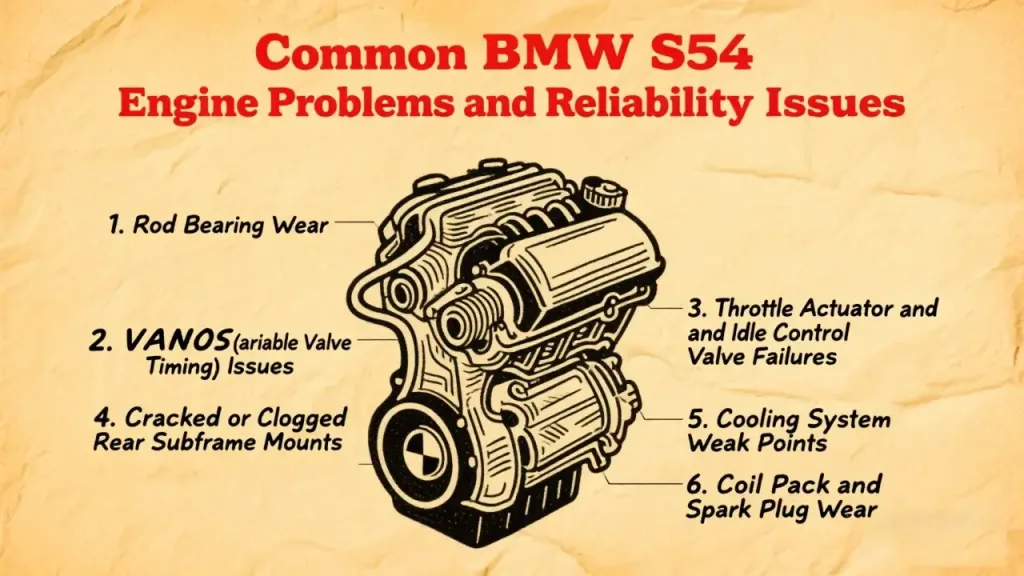
While the BMW S54 engine is widely admired for its performance and engineering, it’s not without its flaws. Like many high-performance engines, the S54 requires diligent maintenance and a knowledgeable owner to stay reliable over time. Understanding its common issues can help you prevent costly repairs, improve longevity, and make informed decisions—whether you’re buying, owning, or rebuilding one.
1. Rod Bearing Wear
Rod bearing failure is the most notorious issue associated with the S54. High-revving engines place considerable stress on the bottom end, and the S54 is no exception.
Symptoms:
- Metallic knocking sounds (especially under load or at start-up)
- Low oil pressure
- Premature engine wear or catastrophic failure
Causes:
- High RPM usage
- Oil starvation or aging oil
- Factory clearances being too tight in early models
Fix:
- Preventative rod bearing replacement around 60,000–100,000 miles is common
- Use quality oil (e.g., 10W-60 recommended by BMW) and frequent oil changes
2. VANOS (Variable Valve Timing) Issues
The double VANOS system enhances power and torque delivery, but it has been a frequent source of trouble for S54 owners.
Common VANOS problems:
- Rattling noise from the VANOS unit
- Loss of low-end power
- Check engine light or poor throttle response
Typical failures:
- VANOS seals and solenoids wear out over time
- VANOS mounting bolts can back out or break
- Cam gear bolts may shear (especially in early builds)
Fix:
- Upgrade to Beisan Systems VANOS rebuild kits
- Replace or reinforce mounting hardware
- Perform VANOS service every ~80,000 miles for best results
3. Throttle Actuator and Idle Control Valve Failures
The S54’s individual throttle bodies are a marvel for performance, but they rely on actuators and sensors that can wear or fail.
Symptoms:
- Erratic idle
- Poor throttle response
- Limp mode activation
Fix:
- Clean or replace the Idle Control Valve (ICV)
- Replace faulty throttle position sensors or actuators as needed
4. Cracked or Clogged Rear Subframe Mounts (Chassis Issue)
While not an engine problem per se, this is a major issue on S54-powered E46 M3s. The torque and load from the S54 can stress the rear subframe mounts, leading to cracks in the chassis.
Symptoms:
- Clunking noises in the rear
- Loose handling
- Visible cracks in the trunk floor or underbody
Fix:
- Reinforcement kits (weld-in) are available from vendors like Redish Motorsport or Turner Motorsport
- Strongly recommended for any E46 M3 under track use
5. Cooling System Weak Points
The S54 runs hot and relies heavily on its cooling system to stay safe at high RPMs. Weak points include:
- Plastic radiator end tanks
- Thermostat housing leaks
- Water pump failures
- Coolant expansion tank cracks
Fix:
- Upgrade to an aluminum radiator
- Replace coolant hoses, thermostat, and expansion tank preventively every 60,000–80,000 miles
- Monitor coolant temps during aggressive driving
6. Coil Pack and Spark Plug Wear
Misfires and rough running can often be traced to ignition coil or spark plug issues, especially on higher-mileage engines.
Symptoms:
- Misfiring under load
- Check engine light
- Hesitation during acceleration
Fix:
- Replace coil packs and plugs every 60,000–80,000 miles
- Use OEM-spec parts for best reliability
How to Maintain the BMW S54 Engine
Proper maintenance is key to ensuring the longevity of your S54 engine. Here are some essential maintenance tips:
Regular Maintenance
- Oil Changes: Regular oil changes are a must. The S54 is known for consuming oil, so make sure to check the oil levels frequently and use high-quality synthetic oil.
- Cooling System Maintenance: Ensure that the radiator, water pump, and cooling hoses are in good condition. Replace any worn-out components before they fail.
- VANOS and Throttle Body Service: Periodically inspect the VANOS system and throttle bodies to ensure they’re operating smoothly.
Upgrades for Performance and Longevity
While the S54 is already an excellent engine, there are a few upgrades you can consider to improve performance and reliability:
- Rod Bearing Upgrades: If you plan to keep your S54 for a long time, upgrading the rod bearings to a stronger design is a good idea, especially if you track the car or drive it aggressively.
- Cold Air Intakes and Exhaust Systems: These can help improve airflow to the engine, providing slight increases in performance and engine sound.
- ECU Tuning: A custom ECU tune can help optimize performance, especially when combined with performance modifications like exhaust and intake systems.
S54 Engine Modifications and Tuning Potential
The BMW S54 engine is already a high-performance powerhouse in stock form, but for enthusiasts looking to extract even more power and excitement, the aftermarket offers a vast world of tuning opportunities. Whether you’re chasing track-day performance, better throttle response, or simply want to make your M car stand out, the S54’s tuning potential is enormous—with the right upgrades and supporting mods.
Naturally Aspirated Upgrades
For those who want to retain the S54’s legendary naturally aspirated character, there are several proven bolt-on and internal upgrades:
1. Performance Air Intakes
- Cold air intake systems improve airflow and reduce intake temperatures.
- Popular options: Eventuri, GruppeM, CSL-style carbon intakes (these also amplify the glorious intake sound).
- Gains: +5 to +15 horsepower, depending on tune and setup.
2. ECU Tuning
- A custom ECU remap (flash tune) optimizes air/fuel ratio, ignition timing, and VANOS settings.
- Tunes can be tailored for bolt-on mods or specific fuel types (e.g., E85, 93 octane).
- Reputable tuners: Epic Motorsports, Evolve Automotive, RK-Tunes
- Gains: Up to +20–30 hp with bolt-ons.
3. Exhaust Systems
- Upgrading the cat-back or headers reduces backpressure and improves flow.
- CSL-style or race exhausts significantly reduce weight and enhance sound.
- Gains: +10–20 hp (especially with a tune and catless headers).
4. Camshafts and Cylinder Head Work
- Upgrading to performance camshafts (e.g., Schrick cams) and porting the head can unleash serious top-end power.
- Often paired with upgraded valve springs and tuning.
- Gains: +30–50 hp when done right.
5. Lightweight Flywheel & Pulley Kits
- Reducing rotational mass improves throttle response and rev speed.
- These mods don’t add horsepower but enhance the engine’s responsiveness—ideal for spirited driving and track use.
Forced Induction: Supercharging and Turbocharging
While purists prefer to keep the S54 naturally aspirated, forced induction opens the door to massive power gains.
1. Supercharger Kits
- Supercharging maintains linear power delivery and drivability.
- Kits from ESS Tuning, VF Engineering, Active Autowerke are well-tested and reliable.
- Gains: +100 to +200 hp depending on kit and boost level.
- Requires supporting mods: upgraded clutch, injectors, cooling.
2. Turbocharger Conversions
- Less common due to cost and complexity, but extremely powerful.
- Custom turbo kits can push the S54 beyond 600–700 hp with built internals.
- Not for the faint of heart—requires standalone engine management, forged pistons/rods, and heavy-duty drivetrain components.
Track and Handling Mods (Supporting Mods)
If you’re increasing power, don’t forget to upgrade the chassis, suspension, and braking systems:
- Oil coolers and baffled oil pans for track reliability
- Upgraded radiators to keep temps in check
- Suspension kits (KW, Bilstein, Ohlins) for sharper handling
- Limited-slip differentials and clutch upgrades to handle the extra power
S54 vs. Other BMW M Engines
The BMW S54 engine holds a legendary status among M enthusiasts—but how does it compare to other iconic M powerplants from different eras? Each M engine brings its own character, strengths, and weaknesses. Here’s a detailed comparison to help you understand where the S54 fits in BMW’s high-performance engine lineage.
S54 vs. S50 (E36 M3 US & Euro)
| Feature | S54 (E46 M3) | S50B30/B32 (Euro) | S50B30US (US) |
|---|---|---|---|
| Power | 333 hp | 286–321 hp | 240 hp |
| Redline | 8,000 rpm | 7,200–7,600 rpm | 6,500 rpm |
| Tech | ITBs, VANOS | ITBs, VANOS (Euro) | Single VANOS |
| Character | High-revving, raw | Similar to S54 | Softer, torquey |
Takeaway:
The S54 is often seen as the spiritual evolution of the Euro S50, offering more power, a higher redline, and improved VANOS technology. It’s far more aggressive than the US-spec S50, which was detuned and lacked many of the features that make the S54 so beloved.
S54 vs. S65 (E9X M3 V8)
| Feature | S54 (I6) | S65 (V8) |
|---|---|---|
| Displacement | 3.2L | 4.0L |
| Power | 333 hp | 414 hp |
| Redline | 8,000 rpm | 8,400 rpm |
| Induction | Naturally aspirated | Naturally aspirated |
| Sound | Inline-6 wail | Exotic V8 scream |
| Reliability | Robust (with care) | Prone to rod bearing & throttle actuator issues |
Takeaway:
The S65 offers more power and a V8 soundtrack, but comes with higher running costs and more complex electronics. Many enthusiasts still prefer the S54’s balance of raw mechanical feel and lower weight, especially for track-focused builds.
S54 vs. S85 (E60 M5 / E63 M6 V10)
| Feature | S54 (I6) | S85 (V10) |
|---|---|---|
| Displacement | 3.2L | 5.0L |
| Power | 333 hp | 500 hp |
| Redline | 8,000 rpm | 8,250 rpm |
| Tech | VANOS, ITBs | 10 ITBs, advanced VANOS |
| Reliability | Moderate (fixable) | High maintenance, SMG |
Takeaway:
The S85 is a technological marvel and race-bred monster—but costly and complex to own. The S54 delivers a more analog, manageable experience while still offering an exhilarating drive.
S54 vs. S55 (F8X M3/M4 Twin-Turbo I6)
| Feature | S54 (NA I6) | S55 (Twin-Turbo I6) |
|---|---|---|
| Displacement | 3.2L | 3.0L |
| Power | 333 hp | 425–503 hp |
| Redline | 8,000 rpm | ~7,600 rpm |
| Induction | Naturally aspirated | Twin-turbocharged |
| Tuning | Limited (NA) | High potential (600+ hp) |
Takeaway:
The S55 is a tuning monster with modern efficiency, but lacks the visceral feel and immediate throttle response of the naturally aspirated S54. Enthusiasts often praise the S54 for its more connected and engaging driving experience.
S54 vs. S58 (G80 M3 / G82 M4 Twin-Turbo I6)
| Feature | S54 (Legacy NA I6) | S58 (Modern Twin-Turbo I6) |
|---|---|---|
| Power | 333 hp | 473–503 hp |
| Tech | VANOS, ITBs | Twin-scroll turbos, DI, valvetronic |
| Feel | Raw, analog | Smooth, high-tech, less visceral |
| Weight | Lighter | Heavier but more refined |
Takeaway:
The S58 is extremely powerful and refined but lacks the analog purity of the S54. For enthusiasts who prioritize driver involvement over raw numbers, the S54 remains a favorite.
Is the S54 Engine Right for You?
The S54 engine is ideal for enthusiasts who crave a high-revving, naturally aspirated driving experience and are willing to stay on top of maintenance. It shines as a weekend toy or track build, offering precision, character, and collector appeal that few modern engines can match.
However, it’s not the best choice for someone seeking low maintenance or a daily commuter car. While incredibly rewarding to drive, the S54 demands care and attention. If you’re passionate about performance and don’t mind putting in the work, the S54 could be the perfect engine for you.
FAQs About the BMW S54 Engine
1. What cars came with the S54 engine?
The S54 engine was used in several high-performance BMW models between 2000 and 2008. These include:
- E46 M3 (2000–2006)
- E46 M3 CSL (2003)
- BMW Z3 M Coupe/Roadster (2001–2002 facelift)
- BMW Z4 M Coupe/Roadster (2006–2008)
- BMW E85 Z4 M and limited motorsport versions (e.g., BMW M3 GTR used a version of the S54 for homologation)
2. Is the S54 engine reliable?
Yes—with proper maintenance, the S54 is a very reliable performance engine. However, it has known issues that require attention, such as:
- Rod bearing wear (especially pre-2003 builds)
- VANOS (variable valve timing) problems
- Cooling system failures
Staying on top of preventative maintenance is key to long-term reliability.
3. How much horsepower does the S54 make?
The S54 produces:
- 333 hp (252 kW) and 262 lb-ft (355 Nm) of torque in most applications (E46 M3, Z4 M)
- 355 hp in the lightweight E46 M3 CSL due to improved tuning and an upgraded air intake system
4. Can the S54 be tuned for more power?
Yes. While it’s naturally aspirated, the S54 responds well to performance upgrades, such as:
- ECU remapping
- Performance headers and exhaust
- Intake systems
- Camshaft upgrades
For more serious gains, some enthusiasts opt for supercharger kits, which can push output beyond 500 hp.
5. What is the redline of the S54 engine?
The S54 has a redline of 8,000 RPM, making it one of the highest-revving production inline-six engines BMW has ever made. The CSL variant is known to rev slightly higher due to a lighter flywheel and fewer accessories.
6. What kind of fuel does the S54 require?
The S54 engine requires premium fuel—typically 91 octane or higher (AKI). Using lower-octane fuel can lead to knocking, reduced performance, and potential long-term damage.
7. What are the most common S54 maintenance issues?
Key concerns to monitor include:
- Rod bearings (replace every ~60,000–100,000 miles)
- VANOS seals, bolts, and solenoids
- Cracked rear subframe mounts (more of a chassis issue, but affects many S54 cars)
- Cooling system components like radiators, water pumps, and expansion tanks
8. How much does it cost to maintain an S54-powered BMW?
Maintenance costs can vary, but expect:
- Annual upkeep: $1,000–$2,500 depending on usage
- Major services (rod bearings, VANOS rebuild): $1,500–$3,000+
DIY mechanics can save significantly, but some jobs are best left to professionals.
9. Is the S54 engine a good long-term investment?
Yes. With the rise of turbocharged and electric vehicles, naturally aspirated performance engines like the S54 are becoming rarer. Clean, low-mileage examples—especially E46 M3s and Z4 M Coupes—are already appreciating in value and are considered modern classics.
10. How does the S54 compare to modern M engines like the S55 or S58?
While newer M engines like the S55 (F80 M3) and S58 (G80 M3) offer more power, efficiency, and tuning potential, the S54 wins in:
- Driving purity
- Mechanical engagement
- Naturally aspirated responsiveness
It’s less about outright speed and more about connection and feel.
Conclusion
The BMW S54 engine stands as one of the most iconic naturally aspirated inline-six engines ever built. With its high-revving performance, motorsport-inspired engineering, and raw driving feel, it represents the pinnacle of BMW’s M Division during the early 2000s. While it requires diligent maintenance and isn’t the cheapest to own, the rewards are well worth it for those who value driver engagement and mechanical excellence.
Whether you’re considering an E46 M3, Z4 M, or simply admiring the engine’s legacy, the S54 continues to earn its place as a modern classic and a favorite among true automotive enthusiasts.


Add comment