
Dodge HEMI 5.7L Engine Common Problems
The Dodge 5.7L HEMI engine is more than just a powertrain—it’s an icon. Found under the hood of RAM 1500 trucks, Dodge Charger sedans, Challenger muscle cars, and Durango SUVs, this V8 has earned a reputation for brute strength and highway presence. Since its 2003 debut, it’s become a favorite among drivers who crave performance without sacrificing utility.
Yet for all its virtues, the 5.7L HEMI is plagued by well-documented issues that can turn ownership joy into frustration. From the infamous “HEMI tick” to catastrophic camshaft failure, these problems often stem from design compromises—especially around its fuel-saving Multi-Displacement System (MDS). The good news? With the right knowledge, you can diagnose issues early, minimize repair costs, and keep your HEMI running strong for 250,000+ miles.
This guide breaks down every critical problem, explains their root causes, and provides actionable solutions—plus recommendations for OEM-quality replacement parts from Wanasign Auto, tailored for U.S. drivers and DIY mechanics.
What Makes the 5.7L HEMI Engine Unique?
Dodge’s Gen III HEMI (fifth-generation of the HEMI lineage) launched in 2003, with the 5.7L variant leading the charge. Its defining feature is the hemispherical combustion chamber (HEMI = Hemispherical), which optimizes air-fuel mixing and allows for larger valves—delivering more power than traditional flat-chamber engines. To balance efficiency with performance, Dodge added the MDS, a cylinder deactivation system that switches between 8-cylinder and 4-cylinder modes during light loads.
This combination made the 5.7L HEMI a hit across multiple models, from workhorse RAM 2500s to street-legal Challenger SRTs. But its innovative design introduced vulnerabilities that reveal themselves over time—especially with neglect or low-quality maintenance.
Specifications Snapshot (Quick Reference Table)
| Specification | Details |
|---|---|
| Displacement | 5.7 Liters (345 cu in) |
| Configuration | Naturally Aspirated V8 |
| Block Material | Cast Iron |
| Cylinder Heads | Aluminum |
| Valvetrain | OHV (2 valves per cylinder) |
| Fuel System | Sequential Multi-Port Injection |
| Power Output | 335–395 hp (model dependent) |
| Torque | 370–410 lb-ft |
| Cylinder Deactivation | Yes (MDS System) |
| Model Years | 2003–Present |
The 7 Most Common Dodge 5.7L HEMI Engine Problems
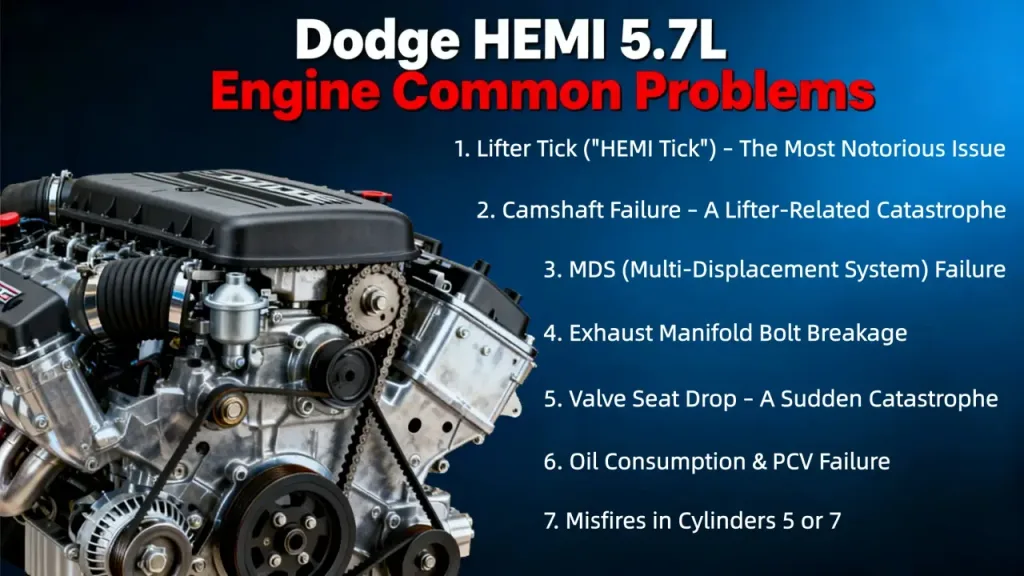
While the 5.7L HEMI is durable, these issues are so widespread that every owner should know how to spot them. We’ve ordered them by frequency and severity to help you prioritize.
1. Lifter Tick (“HEMI Tick”) – The Most Notorious Issue
Ask any 5.7L HEMI owner about common problems, and “HEMI tick” will top the list—some even call it the “tick of death” for its potential to escalate. This sharp, rhythmic tapping noise typically starts in the upper engine bay and grows louder as the engine warms up, especially between 2,000–3,000 RPM.
Symptoms: Persistent tapping/clicking noise (worse under acceleration), Intermittent misfires (P0300–P0308 codes), Metal shavings in engine oil (visible on dipstick), reduced fuel efficiency over time
Root Causes: The culprit is almost always failing hydraulic roller lifters. Four factors accelerate this:
- Oil starvation: Clogged oil passages or low pressure prevent lifters from receiving lubrication.
- MDS stress: Frequent switching between 4/8-cylinder modes wears lifter seals prematurely.
- Low-quality oil: Conventional oil breaks down fast, leaving lifters unprotected.
- Manufacturing flaws: Pre-2014 lifters used weaker roller bearings prone to failure.
Risk of Ignorance: A failing lifter loses contact with the camshaft lobe, causing uneven wear that creates “flat spots.” Within 10,000–15,000 miles, this can destroy the camshaft entirely—turning a $1,500 repair into a $5,000 overhaul.
Repair Solution: Replace all 16 lifters (never just one or two, as uneven wear will persist) along with the camshaft, rocker arms, and lifter guides. Always flush the oil system to remove metal debris.
Cost: $2,000–$4,500 (parts + labor). Labor accounts for 60% of the cost, as the cylinder heads often need partial removal.
Wanasign Recommendation: Use our precision-engineered parts to avoid repeat failures: Cylinder Head Assembly
2. Camshaft Failure – A Lifter-Related Catastrophe
Camshaft failure in the 5.7L HEMI is rarely standalone—it’s almost always a byproduct of neglected lifter tick. The camshaft’s lobes rely on lifters to maintain smooth contact; when a lifter collapses, metal-on-metal grinding wears away lobe material.
Symptoms: Severe hesitation at high RPM (no power during acceleration), Constant misfires (often in cylinders 5 or 7—common LSI keyword), Deep grinding noise (darker and louder than lifter tick), Illuminated check engine light (P0340 camshaft position sensor code)
Design Vulnerability: Pre-2014 HEMIs used softer cast-iron camshafts. While 2014+ models switched to hardened steel, the issue persists if lifter problems are ignored. Cam phaser issues (another LSI keyword) can also contribute, as worn phasers disrupt valve timing and increase lobe stress.
Repair Solution: Full camshaft replacement, paired with new lifters, timing chain, and oil pump. The engine oil pan must be removed to clean out metal shavings—leftover debris will destroy new components.
Cost: $3,200–$5,000 (higher than lifter replacement due to additional parts and labor).
3. MDS (Multi-Displacement System) Failure
Dodge’s MDS was a game-changer for fuel efficiency, but its complexity makes it a frequent failure point. The system deactivates cylinders 1, 4, 6, and 7 by collapsing their lifters—when this mechanism fails, it creates rough running and performance drops.
Symptoms: Harsh jolts when switching between 4/8-cylinder modes. Misfires in deactivated cylinders (RAM 1500 HEMI problems often include this). Check engine light (P0520 or P0340 MDS-specific codes), Worse fuel economy (ironically, the opposite of MDS’s purpose)
Common Failures: Stuck MDS solenoids (clogged by oil sludge), broken lifter locks (preventing cylinders from reactivating), or fried wiring harnesses (damaged by engine heat).
Popular Owner Fix: Many HEMI drivers disable MDS via ECU tuning ($300–$500). This eliminates MDS-related wear and improves smoothness, though it reduces MPG by 1–2. It’s a common solution for Charger/Challenger HEMI issues.
Repair Solution: For MDS retention, replace faulty solenoids and lifters, then flush the oil system. 2019+ models may need a dealer software update to recalibrate the MDS control module.
Cost: $1,200–$2,500 (solenoids + lifters + labor) or $300–$500 for MDS disablement.
4. Exhaust Manifold Bolt Breakage
This issue is rampant in RAM 1500 and Durango models, often mistaken for lifter tick due to its similar noise. Exhaust manifold bolts expand and contract with engine heat; over time, they corrode or fatigue and snap.
Symptoms: Ticking noise that intensifies as the engine warms up (unlike lifter tick), Exhaust leak smell (rotten eggs or burning metal) reduced power from exhaust backpressureFailed emissions tests (common in states like California)
Why It Happens: Pre-2018 models used low-grade steel bolts prone to rust. While 2018+ HEMIs switched to stainless steel, older trucks remain vulnerable—especially in cold climates with road salt.
Repair Solution: Extract broken bolts (often requiring drilling if seized), replace with high-temp stainless steel bolts, and install a new manifold gasket. Warped manifolds (common in high-mileage engines) need full replacement.
Cost: $250–$1,000 (varies by bolt accessibility; seized bolts add labor time).
5. Valve Seat Drop – A Sudden Catastrophe
Valve seat drop is less common but far more destructive. The 5.7L HEMI uses aluminum cylinder heads with pressed-in valve seats; overheating can loosen these seats, causing them to “drop” into the combustion chamber.
Symptoms: Sudden, severe overheating (temperature gauge spikes)Metallic clanking noise (valve seat hitting piston)Complete engine stall (often without warning)
Root Cause: Overheating from coolant leaks, failed water pumps, or neglected cooling systems. Aluminum heads expand faster than steel valve seats, breaking their bond.
Repair Solution: Minor cases may allow cylinder head rebuilding, but most require a new long block assembly. Attempting to reuse damaged heads risks repeat failure.
Cost: $3,000–$8,000 (depends on head vs. engine replacement).
Wanasign Recommendation: Avoid downtime with our ready-to-install long blocks: Long Cylinder Block Assembly
6. Oil Consumption & PCV Failure
High oil consumption is a common complaint in HEMIs with 100,000+ miles. While some burn-off is normal, excessive consumption (1+ quart per 1,000 miles) often traces to PCV valve failure.
Symptoms: Blue smoke from the exhaust (especially during acceleration), Frequent low oil warnings (even with regular changes)Sludge buildup around the oil fill cap
Root Cause: A clogged PCV (Positive Crankcase Ventilation) valve increases crankcase pressure, forcing oil past piston rings into the combustion chamber. Low-quality oil or infrequent changes accelerate PCV clogging.
Repair Solution: Replace the PCV valve (a $15–$30 part) and flush the crankcase. For severe cases, add a high-mileage oil additive to reduce ring wear.
Cost: $50–$300 (parts + labor; DIY-friendly for experienced mechanics).
7. Misfires in Cylinders 5 or 7
Misfires in specific cylinders—especially 5, 7, or 3 (LSI keyword)—are a recurring 5.7 HEMI problem. These cylinders sit closest to the exhaust manifold, making them prone to heat-related issues.
Common Causes: Worn lifters or cam lobes (most frequent) failed ignition coils or spark plugsClogged fuel injectorsVacuum leaks in the intake manifold
Diagnosis Tip: Use a code scanner to confirm the misfiring cylinder (P0305 = cylinder 5, P0307 = cylinder 7). Swap coils between cylinders—if the misfire follows the coil, replace it; if not, inspect lifters or injectors.
Repair Solution: Replace faulty components (coils, injectors, or lifters). For cam-related misfires, follow the camshaft replacement steps above.
Cost: $150–$900 (varies by cause; coils = $150–$300, lifters = $1,200+).
Dodge 5.7 HEMI Reliability: Is It a Good Engine?
The short answer: Yes—if you address its weak points. The 5.7L HEMI’s reputation for unreliability stems from neglected lifter and MDS issues, not inherent flaws. Once these problems are fixed with quality parts, it’s a workhorse capable of 250,000–300,000 miles.
Compared to competitors like the Ford 5.0L Coyote or Chevy 5.3L EcoTec3, the HEMI offers more low-end torque (critical for towing) but requires more proactive maintenance. Its reliability improves dramatically with 2014+ models, which received hardened camshafts and better lifters.
5.7L HEMI Reliability Comparison Table
| Component | Reliability Rating | Common Failure? | Cost to Fix (USD) |
|---|---|---|---|
| Lifters | ★★☆☆☆ | Very Common | $1,200–$2,500 |
| Camshaft | ★★☆☆☆ | Common (lifter-related) | $2,500–$4,500 |
| MDS System | ★★★☆☆ | Moderate | $1,200–$2,500 |
| Exhaust Manifold Bolts | ★★★☆☆ | Common (RAM/Durango) | $250–$1,000 |
| Cooling/Valve Seats | ★★★☆☆ | Occasional (neglect-related) | $500–$8,000 |
| Long-Term Reliability | ★★★★☆ | Good After Repairs | N/A |
Maintenance Tips to Keep Your 5.7 HEMI Reliable for 300,000+ Miles
The 5.7L HEMI rewards proactive care. These simple steps will prevent 90% of its common problems:
1. Use High-Quality Synthetic Oil (Change Every 5,000 Miles)
Lifters and camshafts depend on consistent lubrication. Use 5W-20 full synthetic oil meeting API SN Plus standards (Dodge’s recommendation). Avoid conventional oil—it breaks down too fast, leading to lifter starvation and HEMI tick.
2. Avoid Long Idling Sessions
The MDS system struggles at idle, keeping lifters in a partially collapsed state that accelerates wear. If you’re waiting (e.g., drive-thru, job site), shut off the engine after 2–3 minutes.
3. Replace the PCV Valve Every 30,000 Miles
This $30 part prevents oil consumption and crankcase pressure buildup. It’s a quick DIY job—located on the valve cover—and saves thousands in ring and seal repairs.
4. Maintain the Cooling System Rigorously
Valve seat drop is avoidable with proper cooling care: Flush coolant every 3 years/60,000 miles (use Dodge HOAT coolant). Replace the water pump every 80,000 miles (before it fails). Inspect hoses and belts annually for cracks.
Wanasign Recommendation: Shop our cooling system parts: Cooling System → Water Pumps
5. Consider Disabling MDS (If You Don’t Need the MPG)
Most mechanics recommend MDS disablement for high-mileage HEMIs. It eliminates lifter wear, improves smoothness, and only reduces fuel economy by 1–2 MPG—worth it for longevity.
6. Use OEM-Quality Replacement Parts
Cheap aftermarket lifters or camshafts will fail quickly. Wanasign’s parts meet or exceed Dodge’s OEM specs, with hardened steel camshafts and durable lifters designed for HEMI’s unique demands.
When to Replace the Entire 5.7L HEMI Engine
Rebuilding is often cheaper than replacing—unless you’re facing these scenarios:
- Multiple failed lifters + destroyed camshaft + warped heads
- Valve seat drop or piston damage
- Spun bearings (from oil starvation)
- Metal shavings throughout the oil system (uncleanable)
Replacement Cost: $3,500–$8,500 (Wanasign long blocks cost 20–30% less than dealer engines).
FAQ
Q1: What is the HEMI Tick?
A1: A sharp tapping noise from the upper engine, caused by failing hydraulic lifters, oil starvation, or MDS wear. Ignoring it leads to camshaft failure.
Q2: Why do 5.7 HEMI lifters fail?
A2: Poor lubrication (low-quality oil), MDS system stress, and pre-2014 manufacturing flaws. Frequent 4/8-cylinder switching wears lifter seals.
Q3: How long does a 5.7 HEMI engine last?
A3: 250,000–300,000+ miles with proper maintenance (synthetic oil, PCV replacement, lifter/cam repairs when needed).
Q4: Is the 5.7 HEMI worth rebuilding?
A4: Yes. Rebuilding with quality parts (like Wanasign’s) costs 50% less than a new engine and restores reliability for another 150,000 miles.
Q5: Should I disable MDS on my HEMI?
A5: If your lifters have failed or you drive mostly short trips, yes. Disabling MDS reduces lifter wear and improves smoothness, with minimal MPG loss.
Conclusion
The Dodge 5.7L HEMI is a paradox: a powerful, versatile engine let down by preventable issues like lifter failure and MDS wear. But with early diagnosis, proactive maintenance, and quality replacement parts, it transforms into a durable workhorse capable of decades of service.
At Wanasign Auto, we specialize in OEM-quality parts for the 5.7L HEMI—from lifters and camshafts to complete long blocks. Every part is tested to meet U.S. performance standards, ensuring your HEMI runs strong for miles to come.
Have questions about your HEMI’s tick or misfire? Contact our U.S.-based support team—we’re here to help you keep your engine running at its best.



Add comment